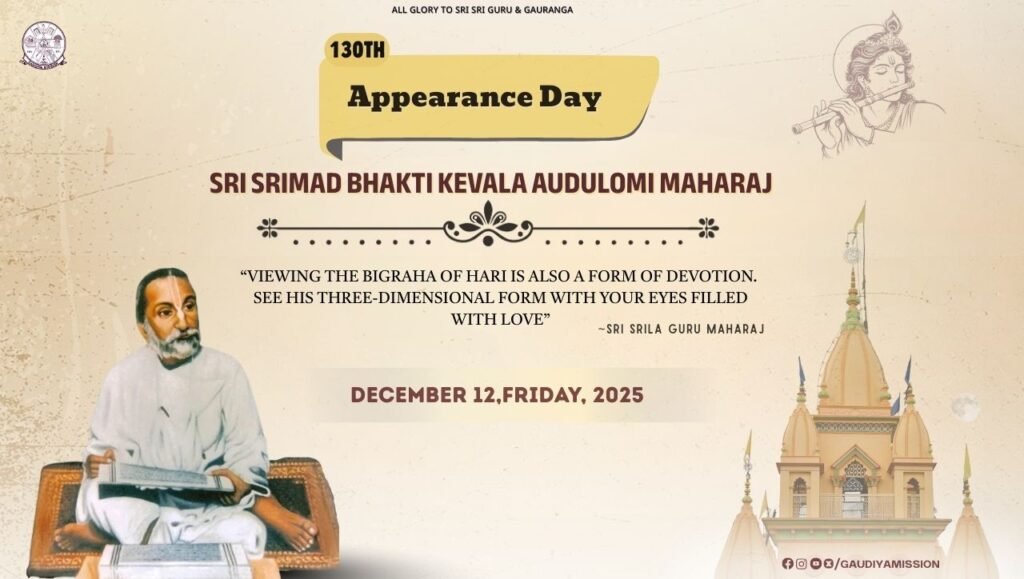

💐 Śrī Śrīmad Bhaktikevala Auḍulomi Mahārāja’s 130th Appearance Day 🌼
December 12, Friday, 2025 📌
Śrī Śrīmad Bhaktikevala Auḍulomi Mahārāja is the beloved junior recipient of the mercy of Oṁ Viṣṇupāda 108 Śrī Śrīmad Bhakti Siddhānta Sarasvatī Gosvāmī Prabhupāda, the establisher of Śrī Śrīman Mahāprabhu’s cherished desire and the prime follower of Swarupa-Rupanuga (those who follow the svarūpa and rūpa aspects of service), who has entered Nitya-līlā (the eternal pastimes).
Śrīmad Bhaktikevala Auḍulomi Mahārāja was one of the preaching sannyāsīs among the monks and brahmacārīs with whom Śrīmad Bhakti Siddhānta Sarasvatī Gosvāmī Prabhupāda initiated his worldwide campaign to propagate Mahāprabhu’s message.
Śrīla Guru Mahārāja was calm, steady, and silent from his childhood. He was adorned with virtues like poetic talent and strength (sabalatā). At the age of eighteen, he received Śrī Harināma (the Holy Name) from Śrīla Prabhupāda. At this time, Guru Mahārāja was also fortunate enough to receive the sight of Śrīla Bhaktivinoda Ṭhākura’s lotus feet. Śrīla Bhaktivinoda Ṭhākura gave him many merciful blessings and affectionately instructed him to study the Śrīmad Bhāgavata scripture.
In 1919 AD, he successfully passed his B.A. degree examination from Calcutta University and studied Philosophy in Kāśī (Varanasi) for some time. His father was Śrīyukta Śarat Chandra Guhathakurata, and his mother was Śrīyukta Bhuvana Mohini. Both were devoted to their own religious practice (svadharma-niṣṭha), regularly engaged in tulasī worship and the service of the Lord. They resided in Banarī Pārā, Barisal. Śrī Guru Mahārāja appeared on Kṛṣṇa Aṣṭamī (the eighth day of the dark fortnight) in the month of Agrahāyan (November/December) in 1895 AD (Bengali year 1302). His childhood name was Śrī Pramoda Bihārī. After completing college, he worked as a teacher for some time. During this period, he also joined Mahatma Gandhi’s Swadeshi movement for a while.
Subsequently, realizing the transient nature (kṣaṇa bhaṅguratā) of everything, he surrendered wholeheartedly to the lotus feet of Śrīla Bhakti Siddhānta Sarasvatī Prabhupāda. During the rites of mantra dīkṣā (initiation), Śrīla Prabhupāda gave him the name *Śrī Patita Pāvana Dās Brahmacārī. In his *brahmacārī life, he performed all kinds of services for the Maṭha, including the worship of the Deities (Śrī Vigraha archanādi). Subsequently, in *1933 AD, Śrīla Prabhupāda granted him *Tridaṇḍa Sannyāsa in *Śrī Mathurā Dhāma. The name given during *sannyāsa was *Śrīmad Bhaktikevala Auḍulomi Mahārāja. After that, he traveled as a *Parivrājaka (wandering mendicant), preaching the message of Gaura all over India.
On *January 1, 1937 AD, Śrī Śrīmad Bhakti Siddhānta Sarasvatī Gosvāmī Prabhupāda, the founder of the Gauḍīya Maṭha Mission, entered *aprakaṭa-līlā (unmanifest pastimes). After his disappearance, Śrī Śrīmad Bhakti Prasād Purī Gosvāmī Mahārāja became the Ācārya (spiritual master and head) of the Gauḍīya Maṭha Mission.
In *March 1940 AD, Śrīla Bhakti Prasād Purī Gosvāmī Ṭhākura entrusted Śrīmad Bhaktikevala Auḍulomi Mahārāja with the serious and responsible task of organizing the *Śrī Navadvīpa Dhāma Parikramā (circumambulation). For seven consecutive years, Śrīla Bhaktikevala Auḍulomi Mahārāja led the management of the Navadvīpa Dhāma Parikramā. Not only did he lead the Dhāma Parikramā, but he also served as the Principal (Adhyakṣa)* of the entire Navadvīpa Maṇḍala and Śrī Caitanya Maṭha. In *1943 AD, he was elected as a member of the Governing Council (Paricaryā Pariṣad) of the Gauḍīya Mission.
He was not content with only dedicating himself to the service of the Śrī Dhāma—a deep enthusiasm for preaching, authoring, and publishing devotional books (bhakti grantha) was evident in him. He translated the book Śrī Caitanya Śikṣāmṛta into English. At this time, Śrīmad Bhakti Prasād Purī Gosvāmī began explaining the Śrī Bhaktisandarbha in Śrī Dhāma Māyāpur. He paid special attention to hearing this. During several years of Ujjvala Vrata (a religious vow), he extensively performed Harikathā Kīrtana (glorification of the Lord) in Dhaka, Mymensingh, and Narayanganj in East Bengal (now Bangladesh). Devoted people gathered from far distances to listen to his nectarous speech. In *October 1953 AD, during the *Ujjvala Vrata on the day of Śāradīya Pūrṇimā (Autumn Full Moon), Śrīla Guru Mahārāja (Bhaktikevala Auḍulomi Mahārāja) completed his bath in the cool waters of Prema Yamunā and, inspired by his Guruvarga (line of spiritual masters), was decorated with the attire of a Paramahaṁsa (a high-ranking renunciant).
In *January 1954 AD, during the Kumbha Melā in Prayāga (Prayagraj), a huge *Nagar Saṅkīrtana (congregational chanting procession) was organized under Śrī Guru Mahārāja’s leadership at the Śrī Rūpa Gauḍīya Maṭha. For several days, he gave immense joy to everyone’s heart by explaining the Śrī Bhaktisandarbha in the Maṭha’s dramatic hall (Nāṭya Mandira).
In *December 1953 AD, Śrīmad Bhakti Pradīpa Tīrtha Gosvāmī Mahārāja, the President of the Gauḍīya Mission, entered *aprakaṭa (unmanifest pastimes) in Śrī Puruṣottama Dhāma (Puri). Subsequently, on *February 16, 1954 AD, Śrīmad Bhaktikevala Auḍulomi Mahārāja was elected as the *President and Ācārya of the Gauḍīya Maṭha and Mission.
At this time, the then Services Secretary (Sevā Saciva), Śrīla Sundarānanda Vidyāvinoda, resigned, and the most worshipable Śrīmad Bhakti Śrīrūpa Bhāgavata Mahārāja took the position of Services Secretary, and Śrīpāda Bhavabandhacchid Dās Bhaktisaurabh became the other Services Secretary. After being installed as the President and Ācārya, Śrīla Guru Mahārāja visited the Maṭhas in various parts of India and provided various instructions, guidance, and nāma mantra dīkṣā (initiation into the Holy Name) to the devotees.
Hare Krishna